



























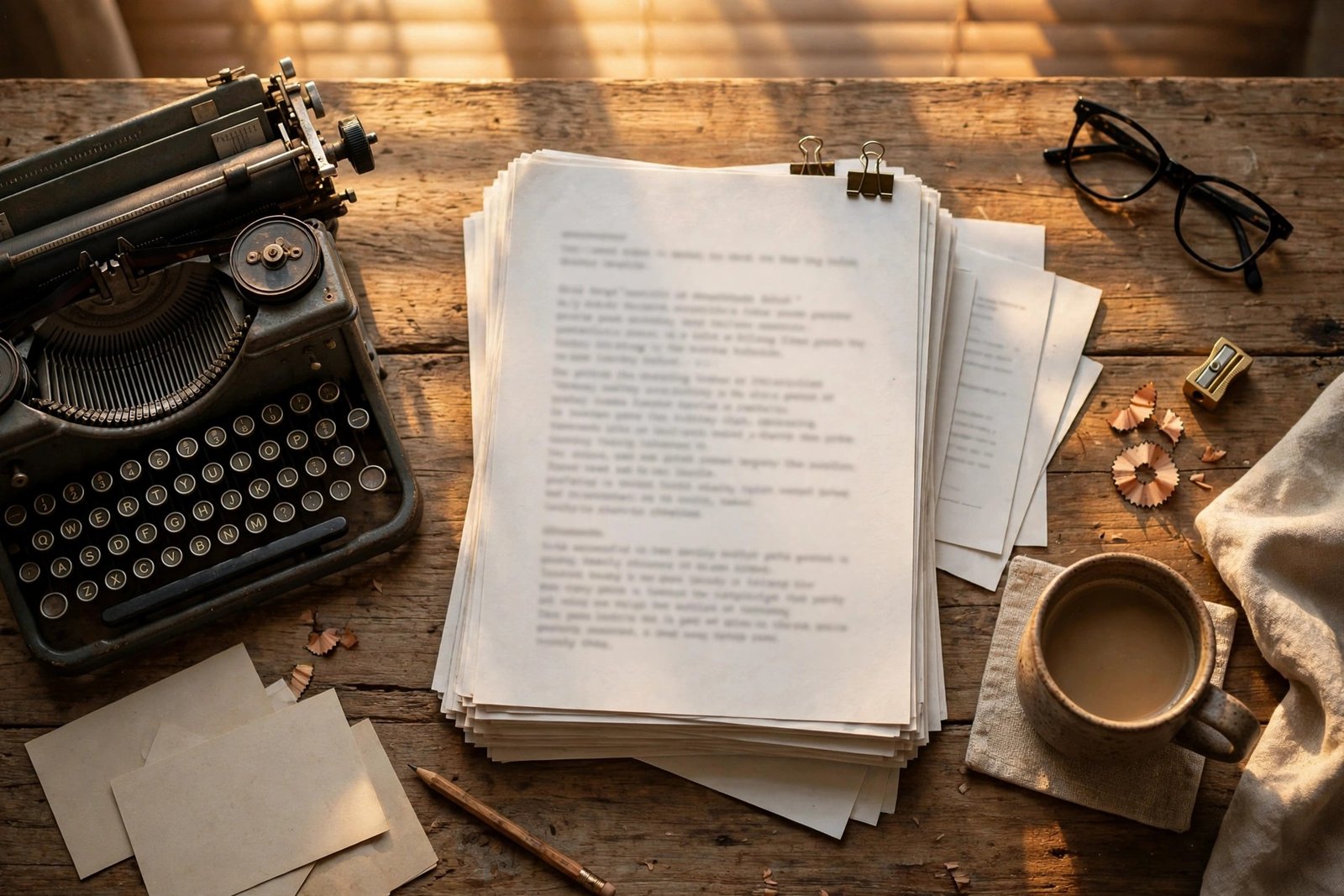
Every screenplay starts as a sentence someone says out loud. “What if two strangers get stuck in an elevator on Christmas Eve?” And then the sentence sits there. Between the idea and a hundred pages is the part nobody wants to talk about: the draft. The promise here is simple. Your idea goes in. A full rough draft comes out. Ninety to a hundred and ten pages.
What does the draft actually promise?
A first version. Not a finished script. A full rough draft, built from your idea, in industry-standard screenplay form: character, situation, scenes, dialogue, enough to work with. The rewrite is the author’s job, and that is the point. A rough draft respects the writer’s job. It gives you structure, arcs, and who is in the room. The voice, the choices, the ending, those are yours.
That matters more now, when AI tools are judged by how finished their output looks. A tool that hands you a finished screenplay takes the writer’s job away. A rough draft gives you the start and leaves the rest to you.
How does it get there?
In three steps, in order. First the take: the tool reads your idea and shows you how it frames the story. You see your idea from the outside for the first time. Then the blueprint: the whole story, scene by scene, laid out for your approval. You cut what does not belong. You fix what is weak. You approve what works. Then the draft, 90 to 110 pages, written with you from the blueprint you approved.
The thinking happens in the blueprint, and you approve the thinking. That is why the draft comes out shaped like a story instead of shaped like a chat transcript. The brain does the storytelling. The AI does the typing.
The brain is Matt Allen’s. He has been in the Writers Guild since 2001, with credits on Four Christmases, Soul Surfer, and Nine Lives, and a craft built on 25 years, 13 editorial points, and 32 governing rules. He built it with Steve Smythe, who built the software system around it. This is not a wrapper. It is not a prompt you could paste into a chat window. It is a screenwriter’s brain, doing the job a screenwriter hates most: getting the first full version down.
What do you do with a hundred pages?
You write. That is the promise, and it is also the work. You cut the scenes that do not land. You fix the middle. You write the ending the story earned. A first draft is not a finished script, and the tool does not pretend it is. That is the whole point of the name.
The test is simple: are you editing yet? If the draft got you to the rewrite, it did its job. Rick put it this way: “Wow I can finally get my grandfather’s memoir finished.” The idea was there for years. The draft is what turns years into pages.
One pass is $97, or $48.50 with the code WRITE101. Launch pricing — half price while the launch offer runs. One time. No subscription. One idea in, one rough draft out, and the writer keeps the pen from there. Get the pass here.
FAQ
Is the rough draft a finished screenplay?
No. It is a full first version, 90 to 110 pages, built from a blueprint you approved. It is never meant to shop around. You finish it.
How long does the draft take?
The draft comes from the blueprint you approved, so the thinking is already done before the drafting starts. The rewrite after that is yours, and it takes as long as it takes.
Who built the tool?
Matt Allen, a screenwriter and Writers Guild member since 2001, with credits on Four Christmases, Soul Surfer, and Nine Lives. He built the tool’s brain with Steve Smythe, who built the software system.
What does the pass cost?
$97 for a one-time pass, or $48.50 with the code WRITE101. No subscription.
About AI Global Entertainment
AI Global Entertainment builds tools and media for writers, storytellers, and creators.